
The EU has overhauled its flight-disruption rules for the first time in more than 20 years. If you fly between India and Europe, the revised EU air passenger rights will matter — but coverage depends on the airline operating the flight and the direction of travel. The new rules apply from 23 October 2027. Until then, the existing Regulation (EC) No 261/2004 continues to govern claims under EU law.
The changes are set out in Regulation (EU) 2026/2202. It was published in the Official Journal on 2 October 2026 and entered into force on 22 October 2026, but its passenger-rights provisions apply from 23 October 2027. A disruption before that application date is not covered by the new provisions.
Which India–Europe flights are covered?
This is the distinction Indian travellers should check before assuming they are protected. Under Article 3, the revised rules cover flights departing from an airport in the EU on any airline, and flights arriving in the EU from a non-EU country when the operating airline is an EU carrier. Flights within the EU are therefore covered regardless of the airline; an India-to-EU flight on an EU airline can be covered, while the same route on an Indian or other non-EU airline generally is not.
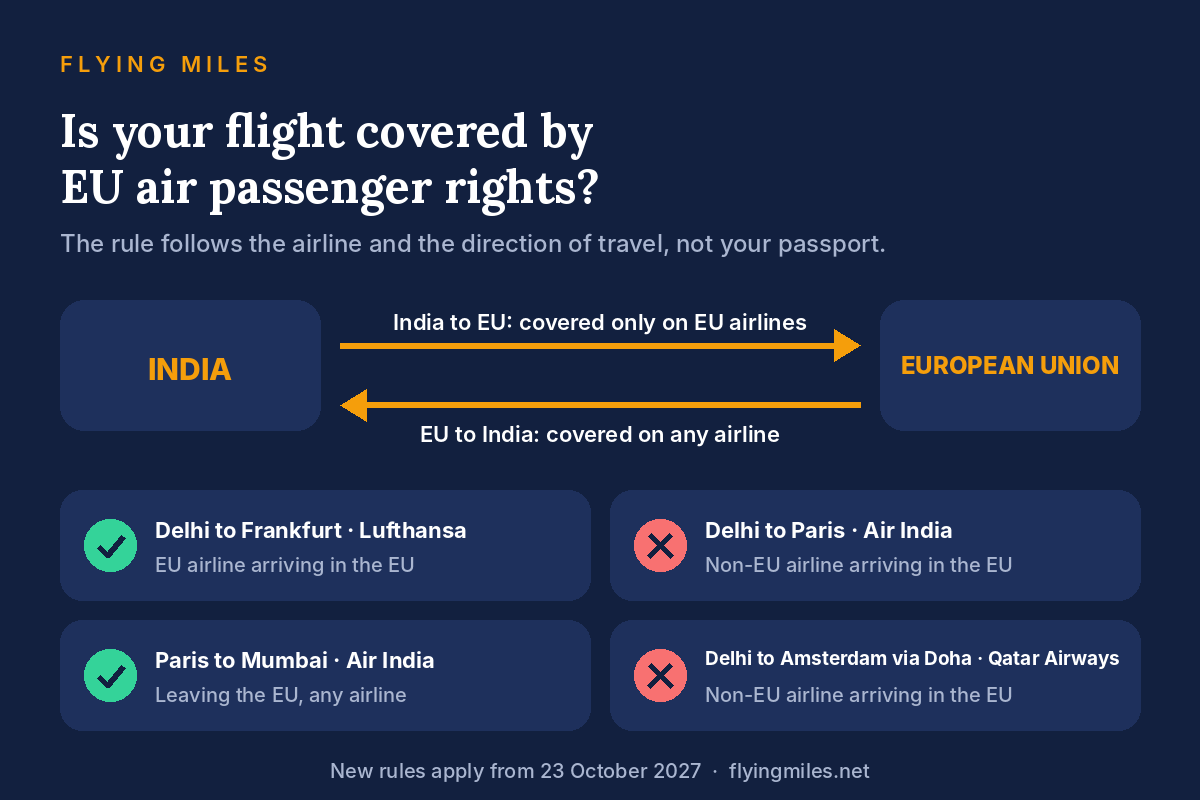
For example, a Delhi–Paris flight operated by Air India is generally outside the EU regulation’s scope. A Paris–Delhi flight is covered because it departs the EU, even if the airline is not European. For an India–Europe itinerary with connections, the regulation’s definition of a journey matters: connecting flights must form part of a single air transport contract, and the outbound and return legs count as separate journeys. Check the operating carrier and ticket structure for each direction, not just the airline whose code appears on the booking.
Where the EU regulation does not apply, other passenger-protection rules may still be relevant. India’s DGCA Civil Aviation Requirements cover disruption-related assistance and compensation for operating airlines, including foreign carriers operating to or from India. The applicable rules depend on the flight and its operating carrier; do not assume that exclusion from EU coverage means there are no passenger rights.
What compensation can passengers claim?
The revised regulation retains the familiar compensation bands: €250 for journeys of up to 1,500 km; €400 for intra-EU journeys over 1,500 km and other journeys between 1,500 km and 3,500 km; and €600 for journeys outside those bands. For a qualifying long-haul India–Europe journey, €600 is the headline amount. Compensation is not automatic in every disruption: the regulation sets out exceptions, including qualifying extraordinary circumstances.
For cancellations, the 14-day rule has an important qualification. Compensation is generally not due if the airline tells passengers at least 14 calendar days before departure. If notice comes later, compensation can still be avoided if the airline offers rerouting that departs no more than one hour before the original departure time and arrives less than two hours after the original scheduled arrival. The airline carries the burden of proving when it informed the passenger.
On journeys in the €600 band, the airline may reduce compensation by 50% in specified cases if the passenger reaches the final destination no more than four hours after the originally scheduled arrival time. The regulation also permits reductions in certain cancellation-rerouting cases where the replacement journey departs earlier. These are conditional reductions, not a blanket rule that every four-hour delay halves compensation.
The regulation also clarifies extraordinary circumstances. An airline must show that the event meets the legal test, caused the disruption and could not have been avoided even if it had taken all reasonable measures. The mere mention of weather, industrial action or another exceptional event does not by itself settle a claim.
What changes under the new EU air passenger rights?
- Faster refunds: if you choose reimbursement after a qualifying disruption, the airline must refund the relevant ticket price and applicable intermediary fees within seven calendar days. Vouchers require your express agreement.
- More rerouting choices: subject to availability, airlines must offer qualifying alternatives that can include another route, an alternative airport, another airline or, where appropriate, another mode of transport.
- Self-rerouting after three hours: if you have chosen to continue your journey and the airline has not offered rerouting under comparable conditions within three hours, you may arrange your own rerouting and seek reimbursement for necessary, reasonable and appropriate costs. Reimbursement is capped at 400% of the ticket price and applicable intermediary fees, with payment generally due within 14 calendar days of the request.
- Clearer claims process: where you may be entitled to compensation, the airline must send electronic information and instructions within 96 hours after the journey ends. Compensation requests must be submitted within nine months of the actual departure date shown on the ticket; the airline then has 30 calendar days to pay or explain a refusal.
- Care while waiting: refreshments are due every two hours of waiting, a meal after three hours and then every five hours (up to three meals a day), plus internet access and two telephone calls. If an overnight stay is necessary, hotel accommodation and airport transfers must be provided. In qualifying extraordinary circumstances, hotel accommodation may be limited to three nights, with exceptions for passengers with specific needs.
- Tarmac delays: at airports in EU territory, when a tarmac delay reaches two hours, the aircraft must proceed to a gate or another suitable disembarkation point. Passengers must be allowed to disembark unless safety, immigration, air-traffic-control or security reasons prevent it.
- Cabin baggage transparency: one personal item must be allowed in the cabin at no extra cost. A piece of hand baggage must be permitted subject to cabin capacity, and fares including a hand-baggage allowance must be displayed by default before booking begins. This does not mean every lowest-priced fare must include a larger cabin bag without charge.
- Fewer avoidable fees: airlines must correct a spelling mistake or make an administrative name update free of charge at least once, if requested no later than 48 hours before departure. They cannot charge for a printed boarding pass when the passenger has already checked in, and cannot penalise a passenger on the return leg for missing the outbound leg under the same contract.
How does this compare with India’s passenger rules?
India’s DGCA rules provide a separate framework for denied boarding, cancellations and delays. The DGCA’s Civil Aviation Requirements, Section 3, Series M, Part IV set out the obligations of operating airlines, including foreign carriers operating to or from India. The compensation and assistance framework is not identical to the EU regime, so the outcome can differ according to the route, operating carrier and disruption. Check the current DGCA document and the airline’s obligations rather than relying on a simple EU-versus-India comparison.
What should Indian travellers do if a flight is disrupted?
- Keep the booking confirmation, e-ticket and boarding passes for every leg.
- Check the operating airline for each flight, not only the marketing airline or flight number shown on the booking.
- For connecting flights, establish whether the legs are covered by one air transport contract.
- Save delay, cancellation and rerouting messages, and record the actual arrival time at your final destination.
- Ask the airline to explain the cause of the disruption in writing and retain receipts for reasonable expenses.
- Use the rules in force on the date of disruption. The new EU provisions do not apply before 23 October 2027.
If you are planning a Europe trip, check the operating carrier and each leg before booking. On an India–Europe return itinerary, the direction of travel can change whether EU passenger-rights protection applies.
Sources: Regulation (EU) 2026/2202 — official text; Council of the EU; India’s DGCA passenger-rights requirements. This article is general travel information, not legal advice. Confirm the applicable rules with the operating airline and relevant authority.